Graduating Executive MBA and Pivoting to Business: What the Future Looks Like
What does the future look like? At least for me personally, it looks a bit different now.
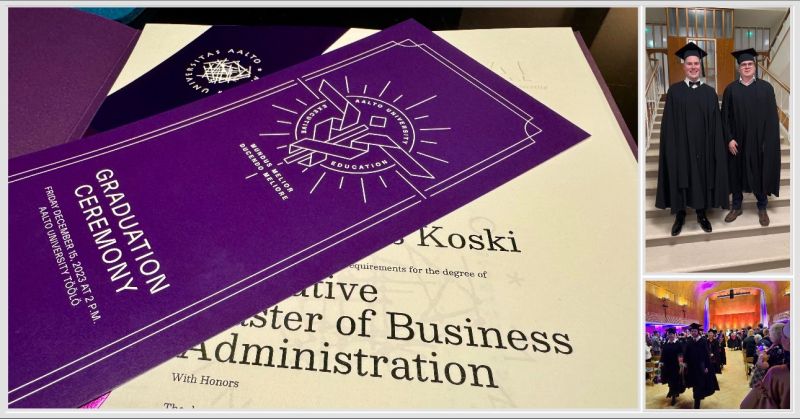
Last week I concluded a major milestone in my professional career as I graduated from Executive MBA at Aalto University. And with that milestone behind me, I’m making a deliberate move: stepping from technology leadership into a business role as Chief Commercial Officer at Knowit Managed Services.
Achieving Something New Means Letting Go
I have been serving in different kinds of expert and leadership roles mostly focusing on the technology side. After the conclusion of my new business education, I am now taking a step towards a business role - which means that it is at least a half step away from a tech role.
Of course, working in a tech company, that step doesn’t take me too far from technology. But nonetheless, I consider this a major turning point in my career. And achieving something new almost always means letting go of something else.
That’s a truth that doesn’t get discussed enough in career development conversations. We celebrate new beginnings but rarely acknowledge what we’re leaving behind. Every “yes” to a new direction is an implicit “less of” something else. In my case, it means less hands-on technical work and more strategic business thinking. Less architecture reviews and more commercial strategy. Less building systems and more building relationships and partnerships.
I don’t say this with regret. I say it with clarity. Knowing what you’re trading away is essential to making good career decisions.
The EMBA Journey
There are so many people who contributed and made this EMBA journey possible, including the support from my employer Knowit - especially Bo Stromqvist, and Tony Hendrell, who also graduated with me from the same cohort.
The faculty and external lecturers at Aalto University Executive Education were numerous and uniformly excellent. Laura Totterman and Annika Karvonen managed our cohort from the beginnings during the pandemic to the very end. Ben Nothnagel guided our self-development journey with all the intellectual debates we had with the cohort.
The most important learning for me personally was that self-development is a journey, not a destination. This was also a front row seat to enjoy and exchange ideas with some of the brightest minds in Finland. The diversity of backgrounds in the cohort - from healthcare to manufacturing to technology to finance - created a learning environment that no single-discipline program could replicate.
One of the defining moments of the EMBA journey was the strategic management module in Singapore. What was unique about that trip was the business cultural immersion, which opened my eyes to how truly global the competence marketplace has become. Standing in Singapore, surrounded by classmates from different industries, discussing business strategy in a cultural context so different from the Nordic one - that experience fundamentally changed how I think about markets, competition, and talent.
Why CCO, Not CTO?
A question I’ve been asked frequently since announcing the move: why take a commercial role when you’ve built your career in technology?
The honest answer is that the EMBA revealed something I’d been sensing for a while. The most impactful technology leaders I’ve observed aren’t the ones with the deepest technical knowledge. They’re the ones who can connect technology decisions to business outcomes. They understand customers, markets, and the commercial dynamics that determine whether a technically excellent solution actually succeeds.
I wanted to build that muscle. Not theoretically through case studies, but practically by owning commercial outcomes. The CCO role at Knowit Managed Services gives me that opportunity - leading commercial strategy and business development with the mission to ensure continued success in the managed services business.
The Broader Pattern
Looking back at the past few years, there’s a pattern I didn’t plan but can now see clearly. Each step - from technical specialist to technical leader, from technical leader to EMBA student, from EMBA student to commercial leader - has widened my perspective while building on what came before.
The technology knowledge doesn’t disappear when you move into a business role. It becomes a differentiator. Understanding the technical foundations of what you’re selling, understanding what’s actually possible versus what’s marketing, understanding the engineering culture you’re working with - these are advantages that a purely business-track executive simply doesn’t have.
Whether this pivot leads to what I expect or somewhere entirely different, I’m making the move with eyes open. The EMBA gave me frameworks for thinking about business strategy. Now it’s time to apply them.
The future looks different. And that’s exactly the point.