The AWS us-east-1 Outage and the On-Prem Fallacy
The AWS us-east-1 outage has been the hot topic for the past few days, and predictably, everyone has an opinion about what it proves. The pattern is always the same: a major cloud provider has a bad day, and suddenly every infrastructure opinion that existed before the outage gets retrofitted as a lesson learned. Most of these takes are pure confirmation bias. People who were already skeptical of cloud see vindication. People who sell on-prem solutions see a marketing opportunity. People who run multi-cloud see proof that their approach is the only sane one. None of them are actually responding to the facts of this specific incident.
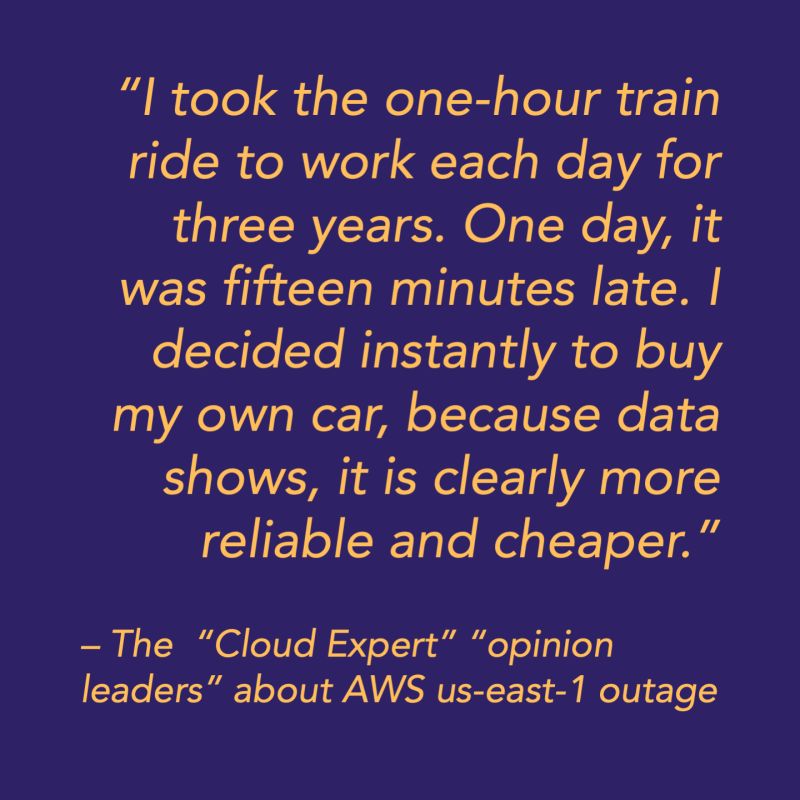
The analogy I keep coming back to is the car versus the train. If a train is delayed or breaks down one day, you don’t conclude that trains are fundamentally broken and everyone should drive their own car. Individual incidents don’t prove systemic failure. Sure, there are cases where driving your own car makes sense – just like there are cases where on-prem is the right call for a particular workload. But making that decision based on a single outage is reactive thinking dressed up as strategy. If you start an on-prem migration because of one us-east-1 incident, you are solving for the wrong problem.
What people conveniently forget is that on-prem has its own failure modes. They just don’t make the news. When your on-prem data center has a power issue or a firmware bug takes down a storage array, there’s no Twitter thread about it. There’s no Hacker News post. There’s just a team quietly working through the night to restore service, and nobody outside the company ever hears about it. The visibility asymmetry between cloud outages and on-prem outages creates a completely distorted picture of relative reliability. Cloud providers report their incidents publicly. Most on-prem shops do not.
The actual lessons from outages like this are far less dramatic than “abandon cloud.” They are about resilience engineering: designing for failure, running multi-region when your workload justifies it, understanding your dependencies, and testing your recovery procedures. These are the same lessons that applied before cloud existed, and they apply regardless of where your infrastructure runs. The question was never “will your infrastructure fail?” – it was always “what happens when it does?” If your answer to that question is “we move to a different infrastructure provider,” you have not answered the question at all.
I have been working with AWS for a long time, and I have seen plenty of outages. Each one makes the platform more resilient because the post-incident engineering is serious and thorough. The confirmation bias crowd will move on to the next outage and repeat the same cycle. Meanwhile, the people who actually build reliable systems will keep focusing on what matters: architecture, redundancy, and operational maturity. Those things matter regardless of whether your servers are in someone else’s data center or your own.