Why I Read a Dozen Books a Month in the Age of AI
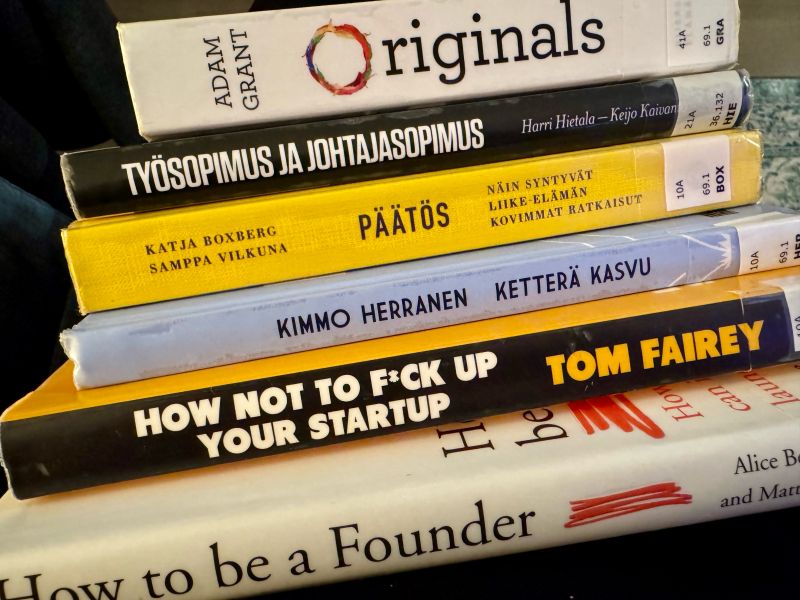
This is only a selection of books I’ve read recently. In total, I plowed through maybe a dozen books during January alone, including audiobooks.
Somewhere around the time after moving from university to corporate life, I lost touch with reading books. I continued learning, but it was very transactional - seeking knowledge at the exact time when I needed it. A Stack Overflow answer here, a documentation page there, maybe a blog post when something was particularly confusing.
During the past few years, my passion for reading has been revived. In big part because studying my Executive MBA required it. But going full startup-founder mode has turned that passion into overdrive.
The Startup Reading Imperative
When you’re running a startup, the range of things you need to understand expands dramatically. You can’t just be deep in your domain anymore. You need to understand sales psychology, financial modeling, marketing strategy, organizational design, legal frameworks, negotiation tactics - and you need to understand them well enough to make consequential decisions.
Books are uniquely suited for this kind of learning. Not because they’re always right, but because they give you structured thinking about a topic. A blog post gives you a tip. A book gives you a mental model. And when you’re making decisions under uncertainty, mental models are far more valuable than tips.
I lean heavily towards non-fiction that combines practical frameworks with deeper thinking. Strategy, business models, technology trends, leadership, psychology of decision-making. The kind of books where every chapter reshapes how you think about a problem you’re currently facing.
Books and AI Are Complementary, Not Competitive
At the same time, I use generative AI very extensively. But I don’t think these two sources for information and insights are exchangeable with each other. They complement each other for maximum output.
Reading gives me the ability to ask the best possible questions. If you don’t know what you don’t know, you can’t ask AI about it. Books expose you to frameworks, concepts, and perspectives that you wouldn’t think to search for. They create the conceptual vocabulary that makes your AI interactions more productive.
AI gives me the ability to apply what I’ve read to specific situations. After reading about pricing strategy theory, I can discuss my specific pricing challenge with Claude and get contextual advice that builds on the theoretical foundation I already have. The AI interaction is richer because I’m bringing conceptual depth to it.
This is a pattern I see consistently. The people who get the most value from AI tools are the ones who bring the most knowledge to the conversation. AI amplifies what you already know. If you know a lot, the amplification is powerful. If you know very little, there’s not much to amplify.
The Finnish Public Library
I’m quite grateful for the Finnish public library system for supporting me in this reading habit. Finland’s library infrastructure is genuinely world-class - not just in terms of physical spaces, but in digital lending, audiobook access, and the sheer breadth of available material.
There’s something almost subversive about the public library in the age of subscription everything. Here is an institution that says: knowledge should be freely available to everyone, no paywall required. In a world where every app wants your credit card number and every platform optimizes for engagement, the library just… gives you books. It’s beautifully simple.
How I Read
My approach has evolved. I typically have three or four books going simultaneously: one physical book for focused reading, one audiobook for commutes and exercise, and one or two digital books for reference. This isn’t about speed-reading or productivity hacking. It’s about matching the format to the context.
Some books I devour in a day. Others I read a chapter at a time over weeks, letting the ideas marinate. The most valuable books are often the ones you read slowly - where each chapter sends you off on a tangent of thinking that’s more valuable than the next chapter would be.
I also re-read more than I used to. There are books I’ve read two or three times, and each reading reveals something different because I’m coming to it with different problems and different experiences. A book about negotiation reads entirely differently when you’re actually in a negotiation compared to when you’re reading it theoretically.
The Reading List Shapes the Thinking
What you read shapes how you think, which shapes what you build. This isn’t a metaphor - it’s literal. Decisions I’ve made at Elexive can be traced back to specific books that gave me the framework to see the situation clearly.
If you’ve fallen out of the reading habit, I’d encourage you to pick it back up. Start with one book about a problem you’re currently facing. Not an article, not a podcast summary - the actual book. Give it the time it deserves. The depth of understanding you’ll gain is qualitatively different from any shortcut.
And if you’re using AI heavily, reading books makes the AI better. Not the model itself, obviously. But your interactions with it. The questions become sharper, the context richer, the outputs more useful. In the age of AI, reading isn’t obsolete. It’s more valuable than ever.
What are you reading right now?