Diversity of Thinking in a Box: Building an AI Advisory Board
This week I created a tool for us to use internally - a bit tongue-in-cheek. I created an external AI advisory board with personalities of well-known public figures, who I can have in a council together or consult as individuals.
Before this, I’d already used our internal AI advisory board for a while, which has persistent memory and specified guardrails. But this was intended to be something different. These advisors do not have persistent memory, on purpose. The intent is to have these maybe a bit over-the-top personalities to critique your ideas from their perspectives and then give you new ideas for what might work and what might not.
It’s sort of “diversity of thinking in a box.”
The Council
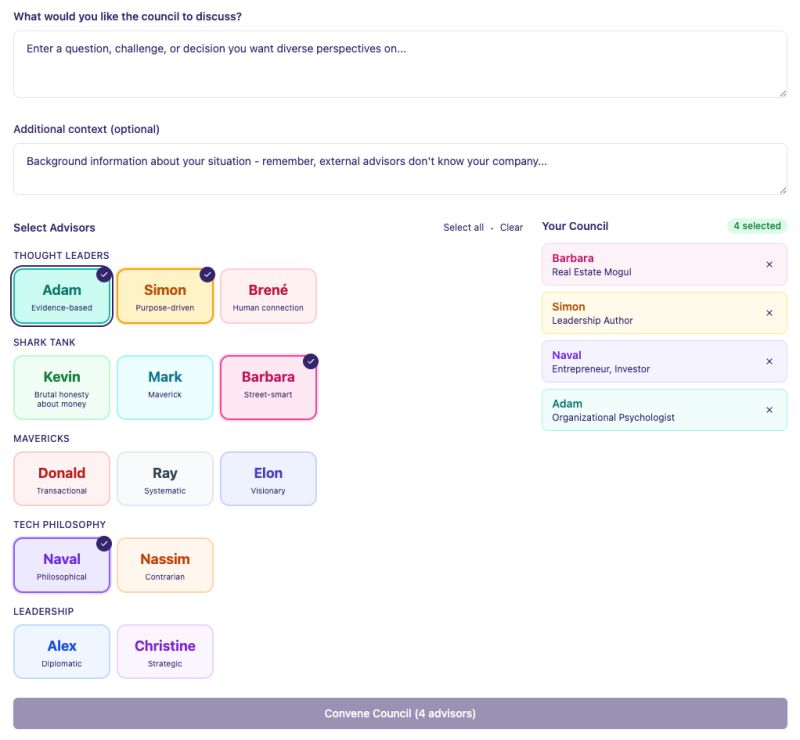
The advisory board is organized into categories, each bringing a different lens to your thinking:
Thought Leaders - For strategic vision and big-picture thinking. Personalities that challenge conventional wisdom and push you toward first-principles reasoning.
Shark Tank - The business pragmatists. These personas evaluate your ideas through the lens of market viability, unit economics, and scalability. They’ll tell you if your idea is a hobby or a business.
Mavericks - Unconventional thinkers who aren’t afraid to be contrarian. When everyone else says “yes,” these advisors will find the angle nobody considered. Sometimes uncomfortable, always illuminating.
Tech Philosophy - Thinkers who operate at the intersection of technology, probability, and systems thinking. They bring mental models and frameworks rather than tactical advice.
Leadership - Perspectives on organizational dynamics, culture, and execution. Because a great idea with poor execution is just an expensive experiment.
How It Works
You present a question, a challenge, or a decision you’re wrestling with. You can provide additional context about your situation - after all, external advisors don’t know your company. Then you select your council - either specific individuals or an entire category - and the advisors deliberate.
Each advisor responds from their own perspective, colored by their known viewpoints and communication style. They might agree with each other, or they might clash dramatically. That’s the point. You’re not looking for consensus - you’re looking for angles you haven’t considered.
The Architecture: Deliberately Simple
Implementation is actually also quite straightforward on our own platform, which we control fully. The personalities are powered by Claude and Skills.
There is no Make. There is no n8n. None of that complexity. Straight up value, which is at our disposal and no dependency to any other external provider, except the LLM provider, which we can also change and adapt on the fly if the need arises.
This is a recurring theme in how we build at Elexive. I have seen these very complex workflows emerge, which people promote, and I am always thinking of simplifying architecture where possible.
Why It Actually Works
The value isn’t in pretending these are real people. To be clear, these are not necessarily copies of the personas - they’re more like caricatures inspired by their style and content topics, maybe “turned up to 11.” So not to be taken too seriously.
But the diversity of perspective is genuinely useful. When you’re deep in your own context, it’s easy to develop blind spots. Having a structured way to pressure-test ideas from radically different viewpoints - the financial pragmatist, the contrarian thinker, the systems philosopher - forces you to address weaknesses you might otherwise overlook.
The most interesting sessions are when the advisors disagree with each other. That’s where the real insight lives - in the tension between different valid perspectives.
The Broader Implication
This tool represents something I believe strongly about AI: it’s most valuable not as a task executor, but as a thinking partner. We already use AI to write code, generate content, analyze data. But using it as a structured way to challenge your own thinking? That’s an underexplored frontier.
Most people use AI by asking “do this for me.” The more powerful question is “what am I not seeing?” An AI advisory board is one way to systematically ask that question from multiple angles.
What do you think of this advisory board concept? Who would you add to your council?