Building an AI-Native Company: Why Simplicity Beats Complexity
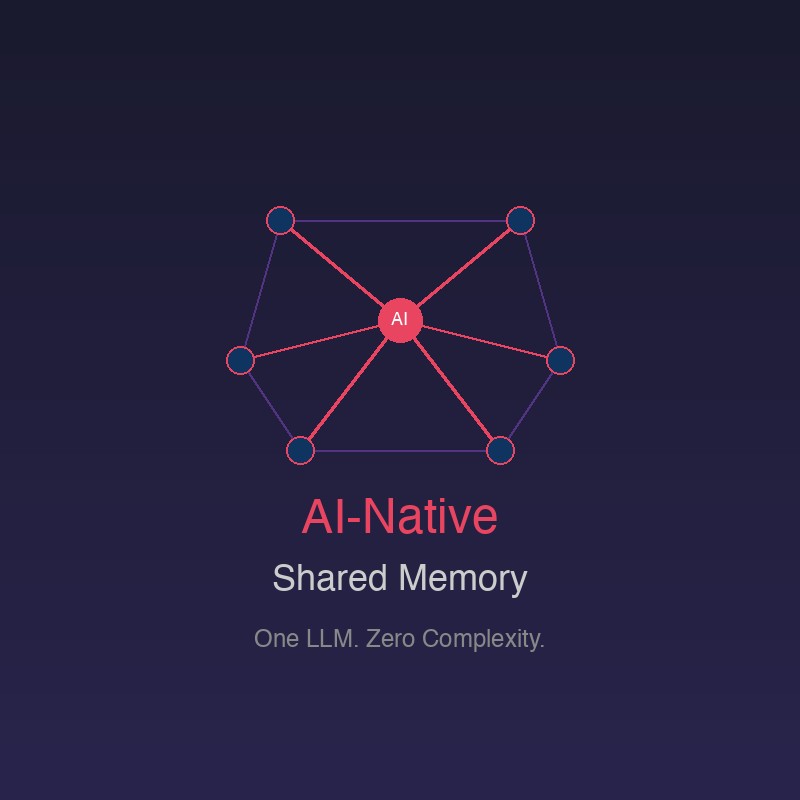
Building an AI-native startup gives possibilities to think different. Instead of acquiring a complex set of SaaS tools, building a shared AI memory which remembers every key decision and which you can have a conversation with has been our approach at Elexive.
We apply this to our strategic thinking, our lead generation, customer work, operational marketing, financial planning, building our offering and products - you name it.
The Problem with Tool Sprawl
I can see that some people are building super complex hierarchies of AI tools. Layer upon layer of services, each with their own API, their own authentication, their own failure modes. The argument is usually about “best of breed” - getting the specialized tool for each job.
But here’s what I’ve observed: many of these setups are fragile. The reliability of any external service becomes the reliability ceiling of your entire workflow. And when you chain together five or six services, your overall uptime is the product of their individual uptimes. That math gets ugly fast.
The n8n and Make Illusion
Lately I’ve been primarily developing next-generation AI agent management systems for customer use. And in the process, I’ve noticed that simplifying things often delivers better results.
You see many publications where people hype really complex workflows that use many different external AI services, and often build additional services on top of those, orchestrated through tools like n8n or Make. The challenge is that the availability of any single external service becomes the availability ceiling of your entire workflow.
Secondly, many complex workflow implementations with tools like Make or n8n can be unnecessary. Surprisingly, many of the examples I’ve seen are ultimately fully linear workflows from input to output, with no state management or decision branches. That’s a strong hint that the workflow can be “collapsed” into a single box.
I’d argue that in many cases, simplifying the workflow adds more quality than a complex chain of external tool calls.
Our Stack: Radically Simple
Our choice has been different. We use Claude Code as the central automation point and everything else is either automated by agentic workflows in Claude or tooling built by Claude. No need to overly complexify with dozens of AI services, which honestly most still are cut from the same cloth and just prompt-prepending tools with nice UI on top.
Our toolset is also super simple. The only real dependency is a large language model, where we primarily use Claude Opus (though the model is interchangeable). The necessary orchestration and integrations happen through Claude’s tool calls, and this adds more quality and reliability than complexity that tries to signal elegance.
There is no Make. There is no n8n. None of that complexity. Straight up value, which is at our disposal and no dependency to any other external provider, except the LLM provider, which we can also change and adapt on the fly if the need arises.
Persistent AI Memory: The Game Changer
The core of our approach is what we call collaborative and persistent AI memory. Instead of every conversation starting from scratch, our AI systems remember context across sessions. Strategic decisions, customer insights, product evolution, market observations - it all accumulates.
Speaking with your company memory in natural language is a game changer. You can ask “what did we decide about pricing in October?” or “what were the key takeaways from our last customer meeting?” and get actual answers grounded in real context. It’s like having institutional knowledge that’s always available and never forgets.
Betting on the Frontier
As the competition intensifies, a lot of tools can also disappear as fast as they emerged. We stick with the ones which are at the frontier but also clearly winning the race. When you bet on a thin layer of tools and the foundation model is your primary dependency, you can adapt quickly when the landscape shifts.
This is not about being anti-tooling. It’s about being intentional. Every dependency you add is a bet - a bet that the tool will continue to exist, continue to be maintained, continue to meet your needs. In a market moving this fast, fewer bets means more agility.
The Question
Are you in camp complex or camp straight to value?
For us, the answer has been clear. Simplicity is not about cutting corners - it’s about removing everything that doesn’t directly contribute to the outcome. And in our experience, the outcomes have been better for it.